
Ducking out of the algorithm: how observing nature develops students’ sustained focus


Created in partnership with

Created in partnership with
You may also like
Exposing children to nature helps them focus more deeply when they return to the classroom. So, I wondered whether tasks requiring university politics students to closely observe elements of the natural world would similarly help them resist algorithmic distractions and extend their attention. In the study of politics, focused attention is crucial for sustained critical thinking, curiosity and attention to developments in the world around you.
I incorporated a fieldwork-based assessment into my module Green Political Thought: Humans and Other Stories, which examines the relationship between humans and the nonhuman world. That included elements such as going to public spaces and observing interactions between species found there (such as gulls, squirrels, pigeons and ducks). Fieldwork assessments are unusual on political theory modules, but reasonably popular on a variety of courses with a “green” element due to the perception that they increase students’ awareness of nature.
Multi-species dialogue, a concept that Dutch philosopher Eva Meijer explains in her 2025 book, requires us to learn other species’ “language” and begin listening and developing a picture of their needs. Meijer’s dialogue partners include mice, frogs and the sea. Both listening and understanding involve sustained focus and close attention to detail.
- A four-step writing protocol to teach students how to practise attention
- Does student attention have a half-life?
- In a world of short attention spans, the best story wins
For my module, I set two main tasks. The first stage asked students to visit a public space and note which animals (including humans), insects and plants used it. Attention was needed to observe whether species interacted and how, and what traces they left. This general multi-species ethnography follows the methods outlined by anthropologist Nils Bubandt and co-authors. The students submitted their field notes, then shared the main points in a seminar, segueing into a brief discussion about the effect on their attention capacity. This thread would be picked up again in later classes.
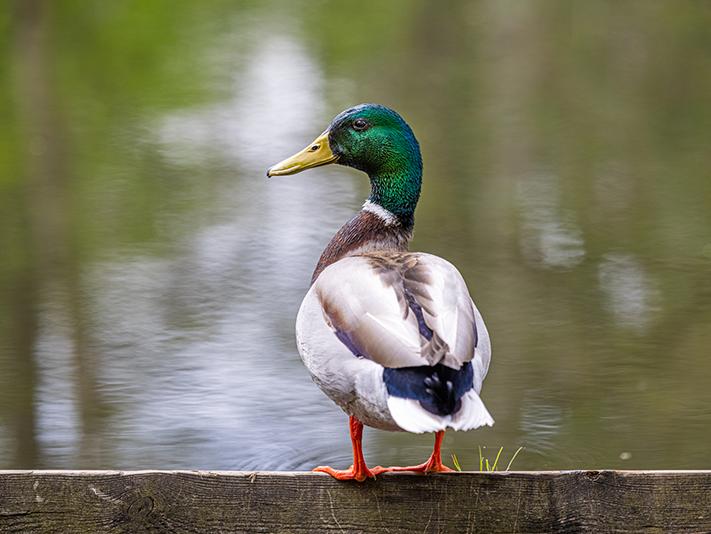
The second stage, which also formed their mid-term assessment, was a dialogue with a nonhuman partner of their choice. Having selected their interlocutor, they had to consider that species’ “language”, a term Meijer uses to cover many forms of communication, including nonverbal actions and responses. What makes pigeons depart en masse? How do ducks show contentment? Students researched their chosen species, then observed them in a sustained way, considering how they might be communicating either with the student or with humans and other species around them more generally. Interactions needed to be benign to the dialogue partner and the wider ecosystem: no feeding ducks bread, for example.
The writing task concluded with a summary of the political interests that might affect their dialogue partner (such as biodiversity loss or water pollution), and the impact that taking these into account could have. What, for example, would Southampton Common look like if it were co-designed with ducks and squirrels? How would the city centre change if gulls and pigeons were consulted about its architecture? (Meijer’s findings imply that feeding stations in locations that humans and birds negotiated would be a good start.)
The purpose of the assessments was to investigate a more-than-human approach to politics, where nonhuman interests are as important as ours and, crucially, how animals’ input might be incorporated into political processes. The physical space of a park or riverbank is the clearest manifestation of whose interests are considered.
I gave students a thorough briefing, using Transparency in Teaching and Learning framework to give them a chance to request clarification. Most wanted more idea of how to express the nonhuman languages they encountered. Some also asked about the level of interaction needed with their dialogue partner. I listed sustained focus as a skill they would develop while completing the tasks.
Informally, many students told me the tasks gave them a new perspective on human-nonhuman relations. Discussion and debating skills improved as students compared notes on their observations. This translated into clearer argument in their essays.
I plan to run the assessment again and collect more data from students. However, I can draw from the responses to my first anonymous qualitative survey. All respondents reported using minimal technology in the observation process; one used the Merlin app to identify bird calls, but that was the main instance beyond using computers to write and submit their work. They all said the tasks helped them focus in a more sustained way than before. The most detailed answer explained that “being required to become more observant meant that we needed to ‘slow down’ rather than walk from point A to point B on a regular walk”. This is promising, because political theory is grounded in the need to think deeply about key issues; in this instance, the relationship between humans and the rest of the world.
To conduct similar research, educators would ideally already have a module covering relevant themes. Cathy Elliott’s Politics of Nature at UCL provides a further case study.
The tasks should include sustained involvement with nature, from literally touching grass to observing animals. Students should be encouraged to develop a thought process that cannot be obtained by asking a search engine or GenAI. I asked students to be as low-tech as possible and use their own observations. It would have been more complicated to programme ChatGPT to incorporate Meijer’s framework, fake sustained observation and create a dialogue without expressly forbidden elements (for example, “the duck said quack”) than to do the task themselves.
Sadly, reducing the reward for shortcuts remains our main defence against cheating. Ideally, students need incentives to do the work properly, such as making it a graded task, and they should be guided towards shared human/nonhuman spaces.
Accessibility is essential. I set individual work, so students could conduct their observations around jobs, children and other needs. However, group trips could work, particularly if you can find a guide with relevant expertise or set a collective task.
The crucial thing is encouraging students to reflect on their experiences, so they become aware of the benefits of the activity. As student mental health, sapped attention spans and inappropriate use of AI become major concerns, forcing learners to pause from scrolling and pay closer attention to the world around them may relieve some of the pressure.
Eloise Harding is a senior teaching fellow in politics at the University of Southampton.
If you would like advice and insight from academics and university staff delivered direct to your inbox each week, sign up for the Campus newsletter.
